Why Do 3D Prints Have Lines? Layer Height, Explained
Run a fingernail across anything that has ever come off our printers and you will feel it: a faint ridged texture, like the grooves on a vinyl record. Those are layer lines, and they are not a flaw in the finish. They are the finish. Every 3D print is a stack of thin horizontal slices, and how thin those slices are is a setting called layer height. It is the single number that decides how smooth a print looks, how long it takes to make, and how much we agonize over it before anything goes in a box.
What layer height actually is
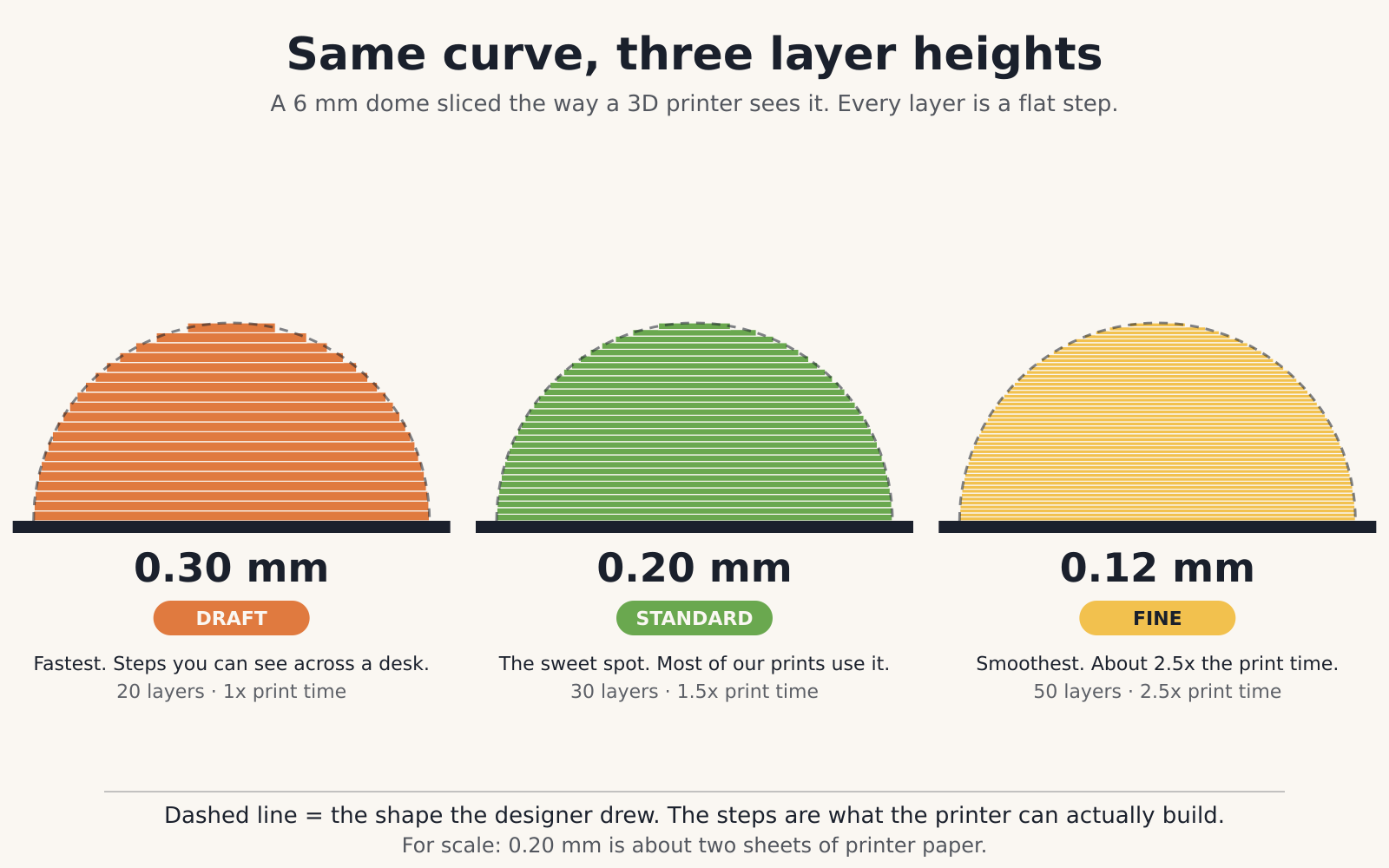
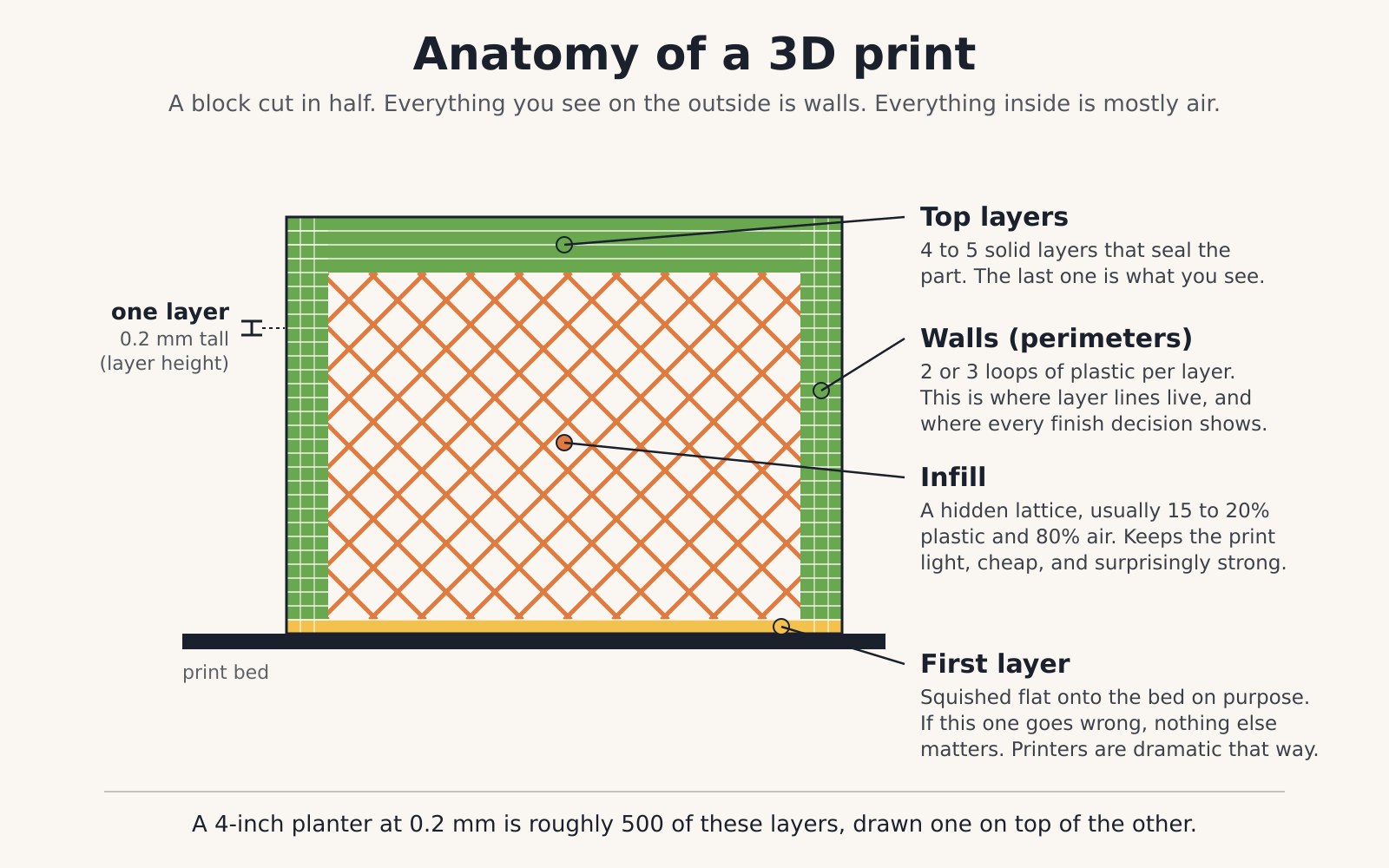
A 3D printer cannot draw a curve going upward. It can only lay down one flat layer of melted plastic, lift the nozzle a hair, and lay down another on top. Layer height is that hair. On most of our printers it is 0.2 mm, which is about the thickness of two sheets of printer paper. A 4-inch textured planter is somewhere around 500 layers, each one a tiny plastic road paved on top of the last.
Because each layer has a flat top and a flat bottom, any sloped or curved surface turns into a staircase when you look closely enough. That staircase is what your eye reads as lines. The gentler the slope, the wider each step, which is why the top of a dome shows lines far more than its sides, and why a perfectly vertical wall barely shows them at all.
The trade-off: detail versus time
Thinner layers mean more layers, and every layer costs time. Drop from 0.2 mm to 0.12 mm and a print takes well over twice as long, for a difference most people only notice in a photograph. Go the other way to 0.3 mm and the printer flies, but the steps get obvious on anything curved. There is no free lunch here, only a dial with “smooth” on one end and “done before dinner” on the other.
For a hobbyist printing one dragon, an extra four hours is a shrug. For a print farm running that same dragon a hundred times, it is a week. That is why layer height is a real business decision for us and not a slider we nudge for fun. Every product in the shop has a layer height we settled on after printing it more times than we would like to admit.
How we pick a layer height for each print
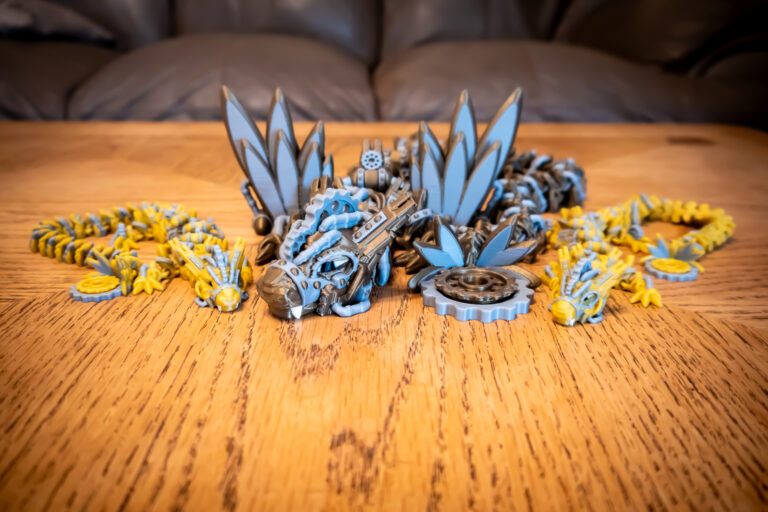
It depends entirely on the shape. Our desk signs are mostly flat faces and vertical lettering. Vertical walls do not show stairs, so 0.2 mm looks crisp and we spend the time budget on thicker walls instead. Curvy, organic things like the scales on the steampunk dragon or the folds on a baby corgi’s face get a notch finer, because that is exactly where the steps would show. And a Zorble gets whatever makes its pop-and-fidget joints move the way they should, which matters more than a mirror finish on a toy that lives in a pocket.
When layer lines are the point
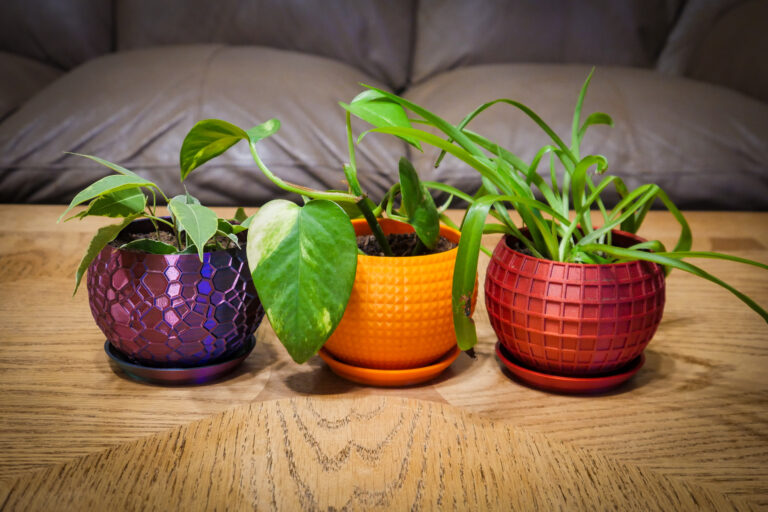
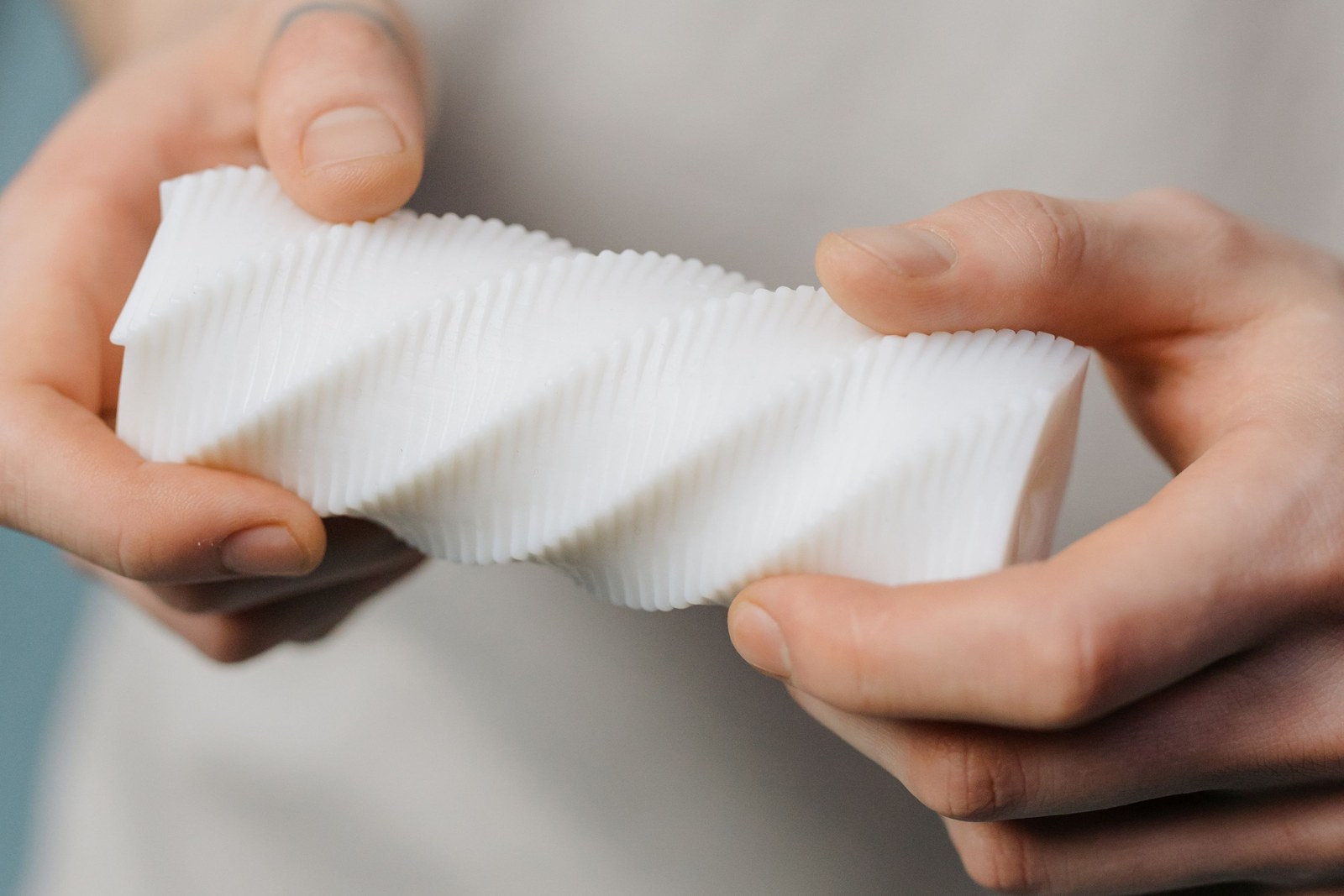
Sometimes we do not hide the lines. We lean into them. The white twist at the top of this post is nothing but layers stacked into a spiral, and it is gorgeous because of the ridges, not in spite of them. Our textured planter works the same way: the grooves are modeled right into the design so the layer lines line up with them and the whole thing reads as intentional, like a ceramic that was thrown on a wheel. Plastic being honest about how it was made is a look, and we are here for it. If you want the full story on that plastic, we wrote one: what PLA is and why we print with it.
Are layer lines a sign of a bad print?
Not on their own. Even, consistent layer lines are the signature of a healthy printer doing its job. What you do not want is inconsistent lines: a band where the layers bulge out or shift sideways, a wavy ripple that repeats every few millimeters, or a single layer that looks thinner than its neighbors. Those are the printer’s way of confessing to a temperature swing, a wobbly frame, or a nozzle that hiccupped for a second. The 3D printing crowd calls it z-banding and layer shifting, and it is why every print here gets a look under a good light before it earns a shipping label. Consistent means healthy. Surprising means it goes in the reject bin, where it is admired briefly and then recycled.
So the next time you run a thumb over one of our prints and feel those ridges, know that you are feeling several hundred small decisions about time, detail, and plastic, made one paper-thin slice at a time. We will not apologize for any of them. We will, however, happily make you more.