No Assembly Required: How 3D Printers Make Toys That Move
There’s a moment everyone has the first time they hold one of our 3D printed articulated fidget toys. You expect a stiff piece of plastic; instead it flops and wiggles like a tiny plastic ferret, and you immediately start looking for the seams. The screws. The pins. Something.
There aren’t any. It came off the printer already moving. No assembly, no glue, no tiny Allen wrench, no step 7 where you cry. This is the part of 3D printing that still feels like a magic trick — so let’s ruin the trick by explaining exactly how it works.
What “Print-in-Place” Actually Means
A 3D printer builds objects one paper-thin layer at a time, from the bottom up. Most of the time that’s used to make one solid thing — a desk sign, a planter, a bracket for that thing in your garage.
Print-in-place designs exploit a loophole: if two parts are printed at the same time with a small gap between them, they come out as two separate pieces that happen to be permanently interlocked. Design a whole chain of linked segments — a head, a dozen body sections, a tail — and the printer builds the entire toy already assembled. Nothing to attach, because it was never apart.
The whole trick lives in that gap. Too small, and the segments fuse into a very disappointing plastic stick. Too big, and the joints feel sloppy or fall apart entirely. The sweet spot is a fraction of a millimeter — a few sheets of paper — and the designers behind these models tune it obsessively. When a print comes off our machines, the first thing we do is flex every joint and make sure each one moves the way it should. It is, admittedly, not the worst part of the job.
The Moving Parts Department: Our Articulated Fidget Toys
Since we’re clearly not able to stop printing these, the store now has a growing lineup of articulated fidget toys. A quick tour:
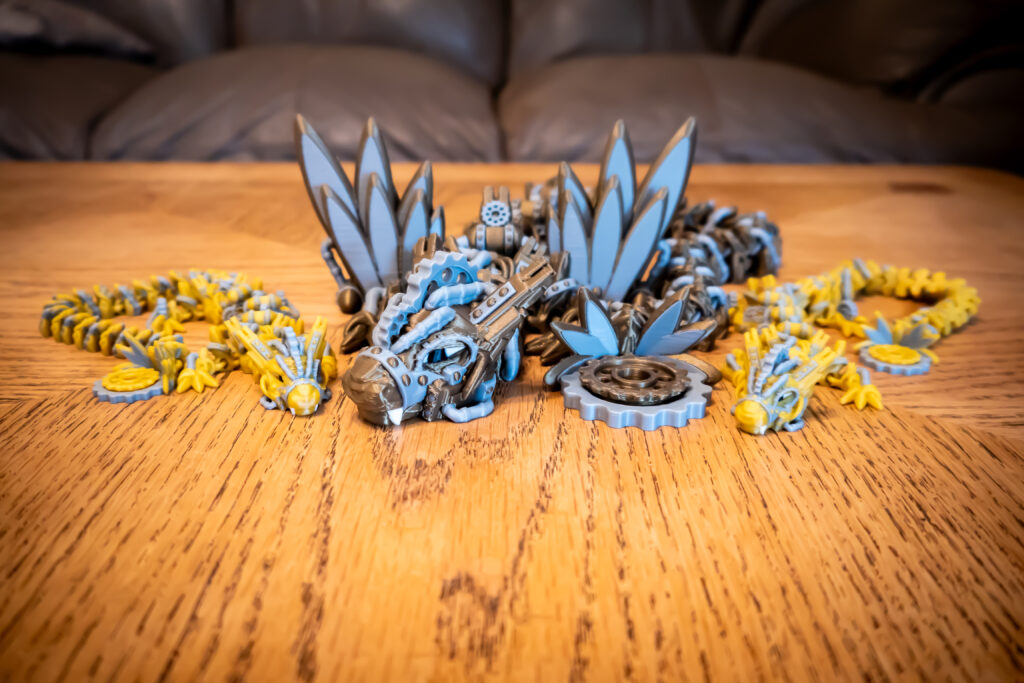
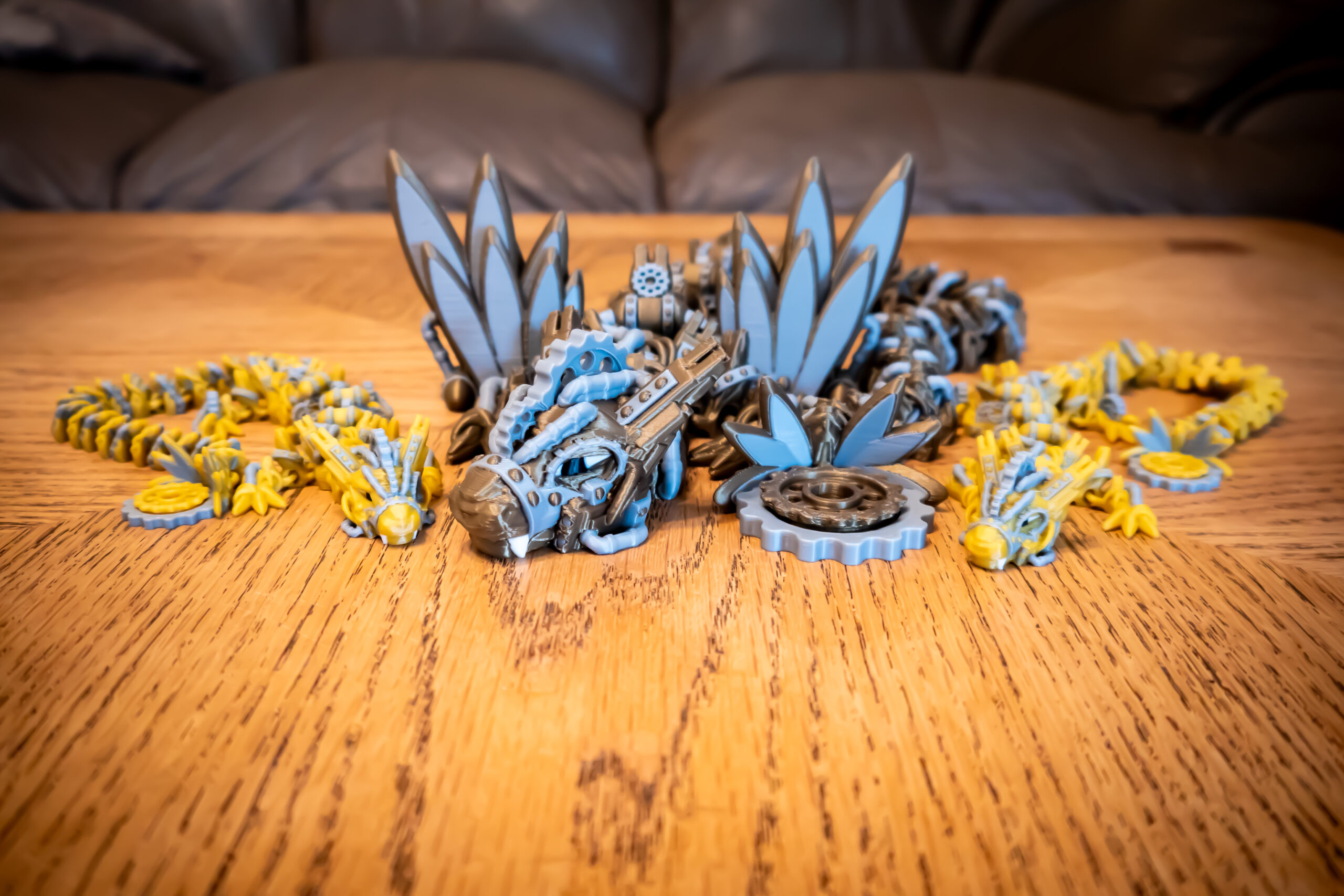
The Steampunk Dragon — the flagship. Gears, riveted plating, chain links, dramatic spine fins, and a tail that ends in an actual working fidget spinner, all printed in one piece. Every segment moves independently, so it coils and drapes wherever you put it and stays there, looking smug. Available winged or wingless.
The puppies — a baby corgi, a baby golden retriever, and a baby pug, each printed as one flexible piece that wiggles when you pick it up and loafs contentedly when you don’t. Available standalone or as keychains, so your keys can finally have a dog.
The Zorble — a different kind of print-in-place cleverness. It’s a little ball of interlocking pieces that collapses flat when you squeeze it and springs back into a sphere when you let go. Again. And again. And again. It even clicks into its own printed carrying case, which — yes — was also designed to snap together straight off the printer.
The Bottom Line
These designs come from genuinely talented designers — the dragon is by Cinderwing3D, the puppies by ZOU3D — and we print every one of these articulated fidget toys to order, in your choice of color, on our own machines here in Utah. Then we flex-test the joints, because quality control occasionally looks a lot like playing with toys.
A quick practical note, since people ask: articulated fidget toys are tougher than they look. Ours are printed with enough wall thickness to survive pockets, backpacks, and enthusiastic desk-fidgeting. The joints never need oil, batteries, or maintenance — the same tiny gaps that let the printer build them assembled are all they’ll ever need. And if a segment somehow gives up after years of loyal service, well — we know a print farm.
Browse the whole squad in our fidget toys collection. Fair warning: they multiply.